.jpg)
Agapanthus 'Ed Carman'
$14.95 Strap-like leaves are green, with variegation running the length of the leaves that can be a golden-yellow to creamy white depending on season and garden conditions. The creamy variegation is echoed in the pure white flowers that come in heads of round clusters. Mature height of 2 or 2½ feet. Needs winter protection from frost. Ed Carman was widely known in California for his nursery's collection of unusual plants..jpg)
Agapanthus 'Summer Gold'
$12.95 A smaller scale plant than the agapanthuses usually seen in gardens, both the leaves and flowers of this have lovely colors. The leaves are striped in creamy yellow. They are evergreen. The flowers are a light to medium blue and low at a height of twelve to eighteen inches. This lily-of-the-Nile is hardy to USDA zone 8 (+10° to +20°F). Introduced from Japan by Barry Yinger. Where winters are colder than Zone 8, it would make a good container plant..jpg)
Agapanthus 'Storm Cloud'
$12.95 Its large clusters of dark violet-blue flowers bloom in summer on stems of 3 to 5 feet. It survives outside in the ground for us over winter, however is recommended for growing in containers, where the pots can be brought indoors for winter protection. USDA zones 7 - 10..jpg)
Allium sikkimense
$9.95 This low growing (6 inches) ornamental onion has sky blue flowers in summer. With its narrow leaves and low height, it is suitable for a rock garden or planted with other low growing flowers at the front edge of a bed. Once established, it is undemanding. It is also known as Allium kansuense. USDA zones 6 - 8 in the East, zones 6 - 9 in the West. Does not seed itself around, though you might wish that it did.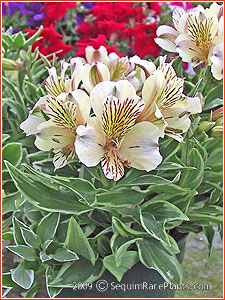
Alstroemeria 'Fabiana'

$10.95 Growing ten to fourteen inches tall, this dwarf will flower a long four months in summer. Hardy in USDA zones 7b to 10, in colder climates it is very easy to overwinter indoors in a pot. It is a good plant for the Deep South, being tolerant of heat and humidity, although it would appreciate partial shade from the afternoon sun. The photo here does not do it justice. The leaves are a rich green edged in creamy white. And the large 2½-inch flowers are a matching creamy white, lightly spotted in yellow and dark red. When one shoot of flowers starts to fade we recommend gently pulling it up, out of the ground, to separate it from the rest of the plant. Doing this will not harm a plant, but allows more room for other flowering shoots to develop.
Arabis alpina subsp. caucasica 'Variegata'
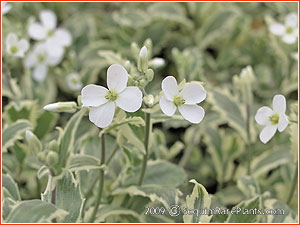
$10.95 Popularly known as rock cress, this unusual form has grayish-green leaves edged in cream that are evergreen, and can light up a garden year around. White, four-petaled half-inch wide flowers appear from early spring until the weather starts warming up. It needs only average soil. The soil having good drainage is particularly important. Doubly colorful with its flowers and foliage, it does good duty in a rock garden, as an edging plant, and planted in the crevices of a rock wall. Native to mountains in Europe, its can survive winter cold to USDA zone 3..jpg)
Arenaria species ex. 'Wallowa Mountains'
$12.95 This very low, spreading plant forms beautifully tight domes of dark green leaves that are best when grown in a trough, crevice or scree. As it spreads it hugs the ground and takes on its undulating topography. Although it rarely blooms, the tiny, almost stem-less flowers are white. Collected from the Wallowa mountains of northeastern Oregon. The species is unidentified..jpg)
Arisaema candidissimum
$27.95 Surviving outdoors without snow cover to -20°F, this species blooms late in spring, with its flower opening at the same time as the leaf. The giant three-parted leaflets continue growing larger after the flower is done. The inside of the flower's hood, the spathe, is pink with white stripes. This is related to jack-in-the-pulpits, however it likes to grow in a drier and better drained soil than its relative, and will rot if its soil is kept too wet. Limited quantity. We advise against growing Arisaemas in containers; they are much easier to grow in the ground.
.jpg)
Arisaema taiwanense
$14.95 Native to semi-tropical Taiwan, this cobra lily reaches 1½ to 2 feet in height (or even up to 3 feet in favored locations). Its flowers open in mid spring before the leaves unfurl, which are large and take some time to fully open. A leaf has a whorl of long, pointed leaflets like the spokes of a wheel, radiating from a centerpoint. The flower is a very dark purple-black hood with a long extended tip emerging from the front, enclosing within a white nobbin called a spadix. It survives outdoors in USDA zones 6 to 9.
.jpg)
Aster nova-angliae
'Alma Pötschke'
$11.95 This aster reaches four feet tall (staking may be necessary) and blooms from late summer into autumn, making it an excellent choice for an eye-popping splash of color at season's end. Not only do butterflies love it, but it makes a good cut flower. It thrives in a wide range of conditions, doing best in full sun and an evenly moist soil. USDA zones 3 - 8, and to zone 9 in the West. A winter mulch is recommended.
.jpg)
Aster novi-belgii 'Tiny Tot'
$11.95 (aka Symphyotrichum novi-belgii) 'Tiny Tot' is a very dwarf form of New York aster. Its height is half a foot, growing bushy, in a rounded bun. From late summer into October small purplish daisy-like flowers will cover the plant. The species name, novi-belgii, derives from 'New Belgium,' that was an early name for New York. USDA zones 3 - 8, to zone 9 in the West..jpg)
Astilboides tabularis
$14.95 This needs moister ground than usual, and filtered sunlight or afternoon shade. It has large, completely rounded leaves, 2 or 3 feet wide on a full sized plant. Unusual and interesting is how the leaf stem attaches underneath to the center of the big, round leaf, making the leaf look something like an open umbrella. Taller than the leaves are its clusters of fragrant, white flowers from summer lasting well into fall that resemble the flowers of Astilbe. The foliage will be two to three feet tall, with flower stems from three to five feet tall. Is very striking alongside a pond. Hardy in USDA zones 5 - 7 in North America, and also zones 8 and 9 along the West Coast.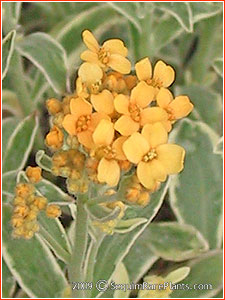
Aurinia (Alyssum)
'Dudley Nevill Variegated'
$10.95 An easy-to-grow, choice perennial that thrives in full sun and hot, exposed sites. It needs soil that is well drained and low in fertility because rich soil promotes sprawling, floppy growth. Rather than growing tall, it grows as an ever-widening mat. We recommend shearing it back lightly just after flowering. Clusters of small, bright apricot flowers cover the plant in spring. The leaves are gray-green edged in cream and are semi-evergreen. Hardy in USDA zones 3 to 7 in the eastern half of the U.S. and hardy in USDA zones 3 to 9 in the West.
.jpg)
Bergenia 'Tubby Andrews'
$12.95 This very cold hardy perennial has evergreen leaves of green and creamy yellow in summer. When cold weather arrives in fall the coloring changes to green and various tints of pink to darker red. The colder the days become, the richer the coloring. As warm weather returns the following spring, the colors revert to creamy yellow and green on the new leaves. Although the plant demands little attention from year to year, we divide it every few years because the variegation is most colorful on a younger plant and becomes more subdued after a few years on an older plant. Pink flowers show in spring, and again in fall. USDA zones 4 - 7 in the East, 4 - 9 in the West..jpg)
Calceolaria 'John Innes'
$10.95 This calceolaria or slipperflower is a hybrid of two species that are native to colder, very southern parts of South America, and it can take quite severe cold, to USDA zone 5. The plant is very low at six inches and spreads slowly wider in a compact mass. The flowers are large in size, the size of a U.S. nickel, and bright yellow, with a few brown speckles on the flower. It likes both good drainage at the same time as not liking to fully dry out, in other words, ground that is moisture-retentive and quickly draining. If allowed to dry out too much in summer it will go dormant early. However just because it disappears above ground, don't think that it has died.
.jpg)
Campanula persicifolia 'Chettle Charm'
$14.95 Among bellflowers, this species is distinct for its tall, thin graceful habit and large bell-shaped flowers. This particular plant has flowers of white, beautifully edged in pale lavender. The height of the flower stems will be to thirty inches. And they make a superlative cut flower for your home. They are the perfect length for a vase and have a long life as a cut flower. Their subtle coloring compliments most any arrangement. Quite cold hardy, to USDA zone 4 (-30 to -20°F). Unfortunately it is not a plant for the deep South.
.jpg)
Campanula cochlearifolia 'Elizabeth Oliver'
11.95 The double flowers of this elfin plant are small and a very light blue in color. Popularly called fairies thimbles, they show for many weeks in late spring in warmer climates, and in summer to fall in northern gardens. The plant's height is four inches, and it spreads modestly without over-crowding its neighbors. It is quite cold hardy, surviving winters where temperatures may drop to minus 20°F, or to minus 40°F if there is snow cover. It likes its roots kept evenly moist and cool. One way to achieve this is with shallow, wide rocks such as paving stones nestled into the soil, and planting this between them -- the soil under the stones stays moister and cooler than the soil in the open ground. The roots will spread out under the rocks and be happier. Campanula 'Elizabeth Oliver' was named for the daughter of a Mr. Bull, of Nottingham, England in the 1970's. The recommended way to propagate it is by dividing in spring or early summer.
.jpg)
Campanula pulla
$12.95 This unusual bellflower grows as a creeping mat from which dangling purple bells show on low 4-inch stems in early summer. Superb as a rock garden plant or spilling over the top of a rock wall. Sun loving. A native to the Austrian Alps, it is cold hardy to USDA zone 5, and with snow cover to zones 3 and 4..jpg)
Campanula 'Royal Wave'
$14.95 Large, open faced blossoms of rich violet-blue flower for many weeks from late spring through much of summer, having an extended season because the blossoms are sterile and will not set seeds. Their rich color lightens at the flowers' centers. The plant grows as a mound of six to eight inches tall and wide. USDA zones 5 - 9..jpg)
Campanula 'Sarastro'
$15.95 The color of this flower is unusual — a smokey grape-purple. It is a very nice hybrid between two species, C. punctata and C. trachelium. It reaches a moderate height of eighteen inches with a long flowering season in summer, and with flower stems that are strong enough not to require staking. Its moderate growth is not rampant. All in all, a wonderful plant to add to a flower garden! Named for a character in Mozart's famous opera, The Magic Flute. In the opera, Sarastro is the high priest of Isis in mythical Egypt, who abducts Pamina, daughter of the Queen of the Night, in order to impart wisdom to her. The color of Campanula 'Sarastro' seems very appropriate for such a character. USDA zones 3 - 9.
.jpg)
Campanula scheuchzeri
$11.95 This species of bellflower grows as a low clump of leaves with purplish blue flowers on stems of six to ten inches. Growing to twelve inches wide, it's low height would be good for a rock garden or at the front of a flower bed. It isn't particular about its soil, although it would like to be watered regularly through the summer, and prefers full sun. Cold hardy to USDA zone 4..jpg)
Campanula troegerae
$12.95 This unusual bellflower, Campanula troegerae, forms low mounds (to eight inches high) of gray-green leaves, covered in fine hairs. In late spring, the flowers start as pale pink buds, opening to become large, white and open-faced. A native to a small region of Turkey. USDA zones 3 to 8. Limited quantity.
Convolvulus cneorum
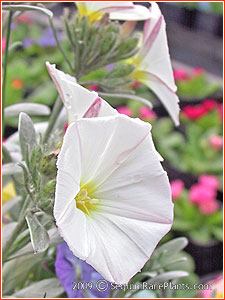
$13.95 Also known as Silver Bush, this is a low, evergreen Mediterranean shrub prized for its silvery foliage and white, trumpet-shaped flowers with yellow centers. Growing to 18 inches tall with a spread of 24 to 36 inches, its narrow silvery leaves are covered with fine silky hairs giving the plant a velvety appearance. Blooms from late spring through summer. The flowers attract bees, butterflies, and hummingbirds but are deer-resistant. Thrives in full sun and prefers well-drained soil, tolerating poor, dry, or sandy soils. It is drought-tolerant once established. USDA zones 8 - 11. A stunning addition for a container garden..jpg)
Cortaderia selloana 'Splendid Star'
$15.95 This dwarf golden-variegated pampas grass is very short, with a mature height of 2½ feet for the leaves, and 3 to 4 feet for the seed plumes. And it is evergreen with narrow, arching leaves of green and creamy yellow, keeping its colors and being attractive all year around, in contrast to many other ornamental grasses than turn brown during winter. Hardy in USDA zones 7 - 11. Cannot be sent to California. Limited quantity..jpg)
Crinum x powellii 'Album'
$11.95 In August and September, these large, pure white trumpets show on stems that are 24 to 39 inches tall. During the afternoon and evening the flowers are sweetly scented, and catch the light of the moon after sundown. The plant grows from a bulb much like an amaryllis, surviving in USDA zones 7 to 10, eventually multiplying into a group of bulbs. It likes a rich, moist soil, though tolerates drier conditions. In colder areas, mulching during winter is recommended. Or it grows well in a pot year-around. This is a hybrid of two species, C. bulbispermum and C. moorei..jpg)
Dianthus 'Chomley Farran'
$14.95 Harking back to an old Flemish still-life, the fuchsia-red and violet-gray bi-colored flowers are large and fragrant. It is said to have appeared as a natural sport of a crimson border carnation in an Irish garden only a short few years ago. Each flower is about an inch and a half wide, fully double, on a stem of twelve inches, and heavy enough to need staking. Hardy to USDA zone 6. Prefers full sun and well drained soil. The bluish-gray leaves are large and evergreen.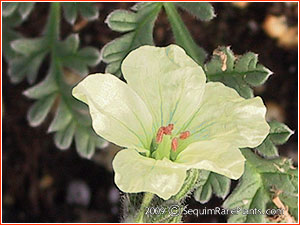
Erodium chrysanthum
$13.95 From Greee, this storksbill or heronsbill needs at least a half day of sunlight for healthy growth. In hot summer climates it would like afternoon shade. Light pastel yellow flowers begin showing in early summer and repeat in fall. It blooms better in a poor, lean soil. Height will be five inches with a spread of twelve inches. Hardy to USDA zone 5. Its leaves are lacey and grayish..jpg)
Farfugium japonicum 'Argenteum'
$17.95 This grows to 2 feet tall, and even to 3 feet with ideal conditions in shade. The round leaves grow up to ten inches across, green with white creamy margins,and sometimes with a touch of pink. The leaves and stems can be lightly covered with downy fuzz, that rubs off when touched. Yellow daisy-like flowers show at the end of summer, often no taller than the leaves. Cold hardy to USDA zones 7 - 11. The large leaves may wilt on hot sunny days, and might not be a sign that the soil is dry. So if they wilt, check before watering. If the roots are kept too wet, they can rot. Also known as Farfugium japonicum 'Albovariegatum' and Ligularia tussilaginea subsp. argentea. The plants are grown in quart-sized pots.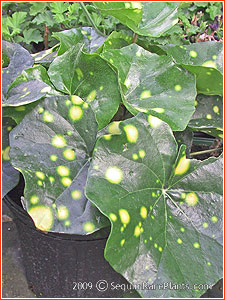
Farfugium japonica 'Aureo-maculatum'
$12.95 Popularly known as leopard plant for its dark green leaves, spotted in yellow. The leaves are large and round, at eight to ten inches across, and glossy. In fall, yellow daisy-like flowers arise on stems about the same height as the leaves. They are eighteen to two feet tall. Needs shade during the afternoon. An ideal location would be a rich soil with partial shade. USDA zones 7 - 11, and possibly to zone 6 with protection. Where winters are colder, it is easily grown in a container and wintered indoors. Its leaves are evergreen and attractive all year round. Keep evenly moist..jpg)
Fuchsia fulgens 'Variegata'
$14.95 Rarely offered, this upright, rounded shrub grows to a size of three tall by four feet wide when planted outdoors. Its roots survive to USDA zone 8 (and even to zone 7 in favored locations). It has flowers from summer to fall colored in salmony pink, cream and orange-red, each flower being long and pendant. This species of fuchsia is native to Mexico. Older plants have tuberous roots resembling the roots of a dahlia. USDA hardiness zones 8 - 10..jpg)
Fuchsia magellanica var. gracilis 'Variegata'
$11.95 This becomes a large plant in milder regions of the country, 4 to 5 feet wide and tall, with small, single flowers and variegated foliage. The flowers are red in the tube and sepals, and deep purple in the corolla. Its leaves are variegated with pink, cream, and green. It's a hummingbird magnet! USDA zones 6 to 9, and to zone 10 along the West Coast..jpg)
Fuchsia magellanica 'Aurea'
$12.95 This golden leaf form of magellanica reaches a mature size of 2 - 3 feet tall and 3 - 4 feet wide. The dangling flowers of red and purple contrast nicely with the yellow leaves. It grows well in partial shade and flowers all summer. Cold hardy to USDA zone 7 (0 to 10°F)..jpg)
Gazania ringens 'Variegata'
$10.95 Blooming continually all summer, from spring to fall, this golden daisy-like flower has flowers that are 2½ to 3 inches across. Its leaves are green and white. A tender plant, it can only be grown outdoors in the ground in USDA zones 9 to 11. In colder zones, it could be grown in a container and brought indoors for the winter, or simply replaced each spring with a new plant. So colorful in both its foliage and flowers, and so long blooming, that more gardeners should grow it. With a height up to just over a foot, it spreads wider, up to two feet. Average to low water needs.
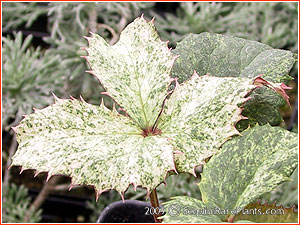
Helleborus 'Janet Starnes'
$18.95 Named for plantswoman Janet Starnes of Molalla, Oregon, who found the original in a batch of seedlings. Its green leaves are dusted with galaxies of white stars. Its new leaves are cream colored, often fringed with pink, while older leaves darken to a marbled green. Clouds of pale green flowers in early spring. Blooms on the previous year's growth. The flowers are showy, but the main attraction is the unusual foliage. This plant produces seeds that will grow into variegated plants. Cold hardy to -10°F.
.jpg)
Hippeastrum x johnsonii
$12.95 Popularly called Saint Joseph's lily, this relative of the forists' amaryllis has trumpet flowers of rich scarlet with a ceamy heart in late spring. Growing from a bulb, it is naturalized in gardens in southern California and the Deep South, and is undemanding in climates warm enough for its survival. To flower well it needs at least a half day of sunlight. In time a plant will produce many smaller bulbs around itself. Lightly fragrant, several flowers are produced per stem. Needs well drained soil. Cold hardy to USDA zone 7.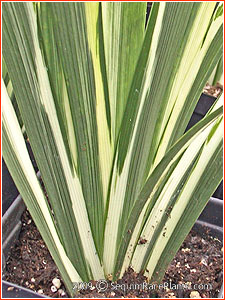
Iris foetidissima 'Variegata'
$12.95 Prefering shade over sun, the dark green leaves are irregularly striped in creamy white. They reach a height of about eighteen inches. Flowering is infrequent on this variegated plant, the flowers being pale lavender and plum. The non-variegated form of this is more likely to produce flowers. The colorful leaves are reason enough to grow this, for they are evergreen and decorate the garden throughout winter. In gardens where winter temperatures drop much below 20°F, the leaves may be damaged and need to be cut back in late winter. Cold hardy to USDA Zone 6..jpg)
Iris graminea
$12.95 In May small reddish purple flowers nestle among the dark green, arching leaves. At close hand they are scented of plums or apricots, not strongly, but lightly. Interesting seed pods follow in fall that have narrow, slightly winged ridges. This iris grows well in average soil. It prefers partial shade. Twelve to sixteen inches tall. Cold hardy to USDA zone 5..jpg)
Iris japonica 'Aphrodite'
$11.95 From Japan, this woodland iris needs shade. Pale, creamy flowers, several to a stem, are shaded in light purple and open in spring. They are 1 to 1½ inches across, fringed at the edges, with spots of orange and yellow dotted at the base of the falls. Plants will spread moderately by thin rhizomes. The leaves are equally streaked in green and cream. Height of the plant is ten to twelve inches. Hardy in USDA zones 7-9, although it can grow as cold as zone 5 in a protected location.
.jpg)
Iris lazica
$11.95 The flowers of this iris are a lovely lavender, and bloom from late winter to early spring on stems about eight inches tall. Prefers partial shade to growing in full sun. USDA zones 7 and 8, and zones 9 and 10 along the West Coast..jpg)
Iris pallida 'Argentea Variegata'
$11.95 Attractive whether in bloom or out of bloom because of its broad, sword-like leaves that are striped in green and white. They are semi-evergreen. The light lavender flowers show in late spring, and are sweetly fragrant. Thrives in any well drained soil, growing well even in heavy clay. USDA zones 4 - 9, and to zone 3 with protection..jpg)
Iris pallida 'Variegata' ('Aureovariegata')
$11.95 The heavenly fragrance of these flowers is reason enough to grow this iris, reminding some folks of grape soda or possibly vanilla. The flowering season is late spring to early summer. The flowers are a light lavender. Flower stems to 3 feet. Leaves to about 2 feet, and are striped in green and a light golden-cream. When planting, set a plant high enough in the ground so the top of the thickened rhizome is not completely buried by earth. And to flower well, more sun than shade is necessary. Hardy from USDA zones 4 - 9, and to zone 3 with protection..jpg)
Iris setosa ssp. canadensis
$10.95 Here is a compact iris of 6 or 8 inches height, blooming in spring with lavender blue flowers. It is very cold hardy, growing well as far north to in USDA zone 2. Lovely in a rock garden or edging a walkway..jpg)
Iris sibirica 'Baby Sister'
$15.95 A young plant of this variety, 'Baby Sister,' when first planted in a garden will be taller, at twelve to fourteen inches, than it will be later on when the clump becomes crowded. Later on, the flowers will top out at eight to ten inches. The three-petaled flowers are a medium purplish blue, with darker veins and with a white blaze. Its season is May into early June. Be sure to plant this deeply enough so that the top of the roots are slightly below the soil surface, and not planted as high as you would a bearded iris. It appreciates being watered regularly throughout the summer, although older plants can take some drought. An oldtime saying for growing a Siberian iris is that, “it likes its toes damp, but its ankles dry.” So its preference is for slightly damp soil. 'Baby Sister' mixes well with other flowers in either full sun or a half day of sun, and it provides rich color in flower and attractive foliage after flowering. Very cold hardy, for USDA zones 2 - 9..jpg)
Iris unguicularis 'Alba'
$21.95 Rarely offered, the golden centers contrast to the pristine white petals on this evergreen iris that likes growing in full sunlight. The height of the plant's leaves will be twelve to fifteen inches, with the flowers being just a bit lower. To allow a better view of the flowers we sometimes cut back the leaves in late autumn. Has a long season of bloom during winter, opening flowers during mild weather. The flower production increases as the plant grows older. Limited quantity. USDA zones 7 - 9, and to zone 10 in the West.
.jpg)
Iris unguicularis
'Mary Barnard'
$18.95 The color of 'Mary Barnard' is a darker purple of this winter-blooming plant. Flowers freely after her first couple of years in a new location. USDA zones 7 - 9, and to zone 10 in the West.

Iris unguicularis 'Walter Butt'
$19.95 This species is native to North Africa and the Eastern Mediterranean. 'Walter Butt' has wide petals of very pale lavender. You will read that this winter-flowering iris needs dry ground and lots of warmth. It does grow well in these condtitions, once it has gained some size, although in my experience dry ground and lots of warmth are not necessary. What seems essential is having enough patience to allow it two or three years to grow thickly enough, before expecting much flowering. An older clump starts to flower in November and continues through winter into early spring. A clump that is a foot or more wide, can produce dozens of flowers in a season. Digging it up to see what's causing all of the flowers, you would see a conjested tangle of branching, inter-locking rhizomes. Allowing the roots to grow this way and not constantly replanting it insures the greatest amount of flowers. A plant will stop flowering in the middle of winter when the temperature drops to +15°F, and resumes flowering when the temperature rises. Hardy to USDA zones 7 to 9, and to Zone 10 in the West. Some gardeners have it survive into zone 6. For us this starts blooming in early November.
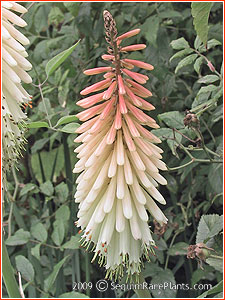
Kniphofia 'Toffee Nosed'
$13.95 The flowers of this are cream, darkening at the top. The flower spikes are lower than most torch lilies, reaching a height of two feet. Grows as a slowly widening clump, that in several years will become long-blooming, beginning in June or early July and continuing for most of the summer. USDA zones 7 - 10..jpg)
Lewisia columbiana var. wallowensis (white form)
$13.95 A small scale lewisia, with short leaves and 6 to 8-inch high sprays of pure white flowers from spring to early summer. A choice rock garden plant. For USDA zones 4 - 8. Native to Oregon..jpg)
Lewisia cotyledon var. howellii
$14.95 Found in the wild at 5600-ft in the Klamath Range of California. It's a low plant, and in spring there are very low, short stemmed clusters of creamy flowers with pink veins. USDA zones 4 - 8. Limited quantity..jpg)
Lewisia 'Little Peach'
$11.95 The peach flowers of this succulent are lightly blushed with pink and yellow, that bloom in mid-spring and a second time in late summer. 'Little Peach' is evergreen and grows 4 to 6 inches high and 6 to 8 inches wide. Its soil needs excellent drainage. Not a plant for the Deep South, in hot summer climates it does better with partial shade. A hybrid of Lewisia longipetala x cotyledon. USDA zones 5 - 8, and zones 9 and 10 in the West..jpg)
Lewisia 'Rainbow Mix'
$10.95 This is a colorful hybid Lewisia with pinwheel flowers that change color as they age. New flowers open in two-toned pink, and turn lightly golden with age. Many buds will open in sucession on older plants giving you both young, pink flowers and older creamy golden flowers at the same time. Long blooming in spring to early summer. The thick fleshy, evergreen leaves are attractive in their own right. USDA zones 5 - 8, and zones 9 and 10 in the West..jpg)
Manfreda (Agave) 'Spot'
$10.95 “deciduous agave” -- A hybrid between Manfreda virginica and Manfreda maculosa (“Texas tuberose”), this plant has gray-green leaves speckled with sizable spots of reddish brown. It is cold hardy USDA zone 5 (-20°F) when situated where the soil drains freely. Older plants, in time, will grow into a thick clump of shoots connected at their roots. The leaves grow to a height of 12 to 15 inches, with taller flower stems to 4 feet.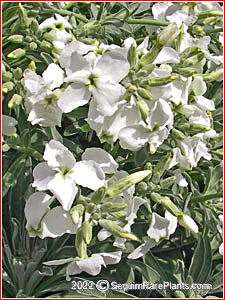
Matthiola perennis 'Alba'
Stock. These are offered as a packet of 100+ seeds, not as plants. This plant isn't long lived, three or four years is all. It is wonderfully fragrant, with bright white flowers contrasting to its gray leaves. And is native to the Mediterranean region, so hot, dry summers don't faze it. Grows best in USDA zones 7 to 9. In colder places it can be enjoyed as a potted plant, if protected over winter. It develops woody stems into a low bushy shape, that is 12 to 18 inches high, and 12 to 24 inches wide. There is no additional cost for these seeds. If you'd like a packet, just ask for them in an email when you place your order, and we'll include them when the plants are sent. Limited quantity. To sow the seeds, do not cover with soil, but lightly press them into moist soil..jpg)
Parochetus communis
$10.95 Known as both blue oxalis and shamrock pea, this is native to the mountains of Africa and Asia. It is low at 1 to 3 inches tall and spreads widely to a couple of feet or more. The green leaves often have a circle pattern of dark red. The cobalt blue flowers are unbelievable at first sight. Flowers are produced for a long season. Plant it outdoors in the spring to give it a good start, and it will survive over winter to USDA zone 8b..jpg)
Pelargonium x fragrans 'Snowy Nutmeg'
$11.95 Pelargonium x fragrans 'Snowy Nutmeg' has green leaves irregularly splashed with cream that are gloriously scented. A small-scale scented-leaf geranium, its leaves are up to about an inch wide. It isn't reliably frost hardy, although it may survive outdoors in USDA zones 7 and 8 in a protected location such as under the eaves of a house. White flowers bloom thru summer..jpg)
Phlox glaberrima 'Triple Play'
$12.95 The leaves are green and cream, tinged in pink during fall and winter. A low and spreading plant, the lavender-pink flowers are taller at 4 to 8 inches and bloom heavily in late spring with a second bloom at the end of summer. And they are favorites of hummingbirds and butteflies. Cold hardy from USDA zones 4 to 8, Phlox glaberrima is native from Wisconsin south to Florida. If several are planted as a group, space them about 8 to 10 inches apart..jpg)
Phyteuma schuechzeri
$14.95 Not frequently offered at nurseries, the common name of this is horned rampion. It is a close relative of bellflowers, Campanula, although the flowers are quite different in appearance from bellflowers. Each flowerstem holds a ball-shaped cluster of violet-blue flowers, and long, spiky bracts, that have a light, dainty character. Horned rampion hails from the mountainous Alps of Europe. Hardy to USDA zones 6 to 9, and to zone 5 with protection. Its flowering season is early to mid summer, and blooms at a height of eight to ten inches.
.jpg)
Podophyllum pleianthum
$14.95 The common name for this is Chinese mayapple. It has large, shiny rounded leaves from one to two feet tall. They may grow to the size of a large dinner plate and are very decorative. Richly dark red flowers bloom on the leaf-stems underneath the leaves. The flower buds do not open all at once, but one after another. An older plant will have many buds so that the flower season lasts for quite some time. This plant needs shade all day long to be happy, because direct sunlight will burn any part of the leaf that it touches. Hardy in USDA zones 6 - 8, and to zone 9 along the Pacific Coast..jpg)
Primula 'Drumcliff'
$12.95 A dark leaved primrose with creamy pink flowers, 'Drumcliff' is very cold tolerant, surviving to +5°F. Height of 4 to 6 inches. Both spring and autumn blooming. And even during winter in the South.
.jpg)
Primula 'Penumbra'
$10.95 Multicolored flowers of black with a wide white edging and golden eyes are showy and bright. The flowers come in clusters atop four-inch stems in spring and again in fall. The leaves are light green and can be evergreen depending on he severity of the winter. USDA zones 6 to 9, and to zone 5 with protection. With good snow cover it is routinely carried over winter in zones 3 and 4.
.jpg)
Primula 'Sue Jervis'
$12.95 Flowers of light, candy pink are double. As a flower ages, her petals lighten to a creamy pink. For growing conditions, dappled shade and damp but well-drained soil is recommended. To encourage vigorous growth and prolific flowering, dividing the double primroses every year or two is best, and adding some compost or organic fertilizer to the soil. Hardy in USDA zones 6 - 9, zone 5 with protection..jpg)
Primula sieboldii 'Snowflake'
$10.95 Blooming from early April to late May, the pure white flowers of 'Snowflake' have lacey margins. The flowers come in clusters on stems up to about nine inches high. It doesn't like too much direct sunlight, but thrives in filtered shade. A humusy soil that is rich in leaf mold is much to its liking. Don't be surprised to see it going dormant early, before the end of summer. This is normal for it and doesn't mean that it won't return to be bigger and better the following year. We advise you to make a note of where it's planted so that you won't lose track. Slowly growing into a clump, it also will spread wider into a colony. It may even migrate short distances because new plants can form on its spreading roots. Hardy in USDA zones 5 - 8 (and to Zone 9 along the coastal regions of the West)..jpg)
Rhodanthemum hosmariensis
$10.95 (roe-'dan-the-mum) Originally from Morocco, this is a superb flower and foliage plant for a sunny site, with pristine white daisies that is seldom without bloom from spring to autumn. In milder parts of California it even flowers through winter. The silvery leaves are evergreen and attractive at all seasons. Reaches a size of 8 to 10 inches high, by 24 inches wide. Give it ground that drains well. Otherwise, very low-maintenance and easy to grow. Especially nice when added to a large container of sun-loving flowers. Also it is attractive drapping over a rock wall or as an edging plant, among other possibilites. Tolerates drought very well. Hardy to +15°F..jpg)
Rosa 'Clementina Carbonieri'
$14.95 A tea rose, this vigorous, low bush has fragrant ever-blooming flowers of pink, salmon and yellow. Its height is approximately three feet tall, with a two-foot width, and has few thorns. It was first registered in 1913. Cold hardy to 0°F..jpg)
Saxifraga paniculata ssp. petrophila
$10.95 Tight growth and small evergreen leaves define this creeping perennial. The leathery leaves are toothed with distinctive lime-encrusted pores on each leaf. Its native habitat is arctic and alpine regions, so it survives well to -30°F. In gardens, shading it from the hot afternoon sun is advised, at least where summers are especially warm. The scale of this plant is very small. Dainty, creamy flowers come in May/June on stems of six to eight inches tall..jpg)
Saxifraga stolonifera
'Harvest Moon'
$10.95 'Harvest Moon' prefers more shade than sun, however if grown in too much shade the leaves will be more green than golden. So a fair degree of bright sunlight is necessary. You will notice that the higher, more exposed leaves will be more golden, whereas the lower, more shaded leaves will be darker and greener. It has tiny white flowers on stems twelve to fifteen inches tall in late spring to early summer. Despite the fact that it does spread by runners, it is one of the easiest plants to keep under control because the plants are so often delicately rooted into the ground. It tolerates dry gound well, and would be a good choice for a groundcover in dry shade. When grown in a pot let the soil dry out considerably more than you would most potted plants. When grown in a pot, if its soil is kept constantly wet, the roots will rot. USDA zones 5 - 9. This plant thrives on neglect.
.jpg)
Saxifraga stolonifera
'Tricolor'
$10.95 Lightly hairy evergreen leaves are edged in cream with pink highlights. This perennial is hardy from USDA zones 5 to 9. One of its common names is mother of thousands, referring to the many baby plants that will grow from it on runners. Although others recommend growing it in moist but well drained soil, our experience suggests that is it better to let the soil dry out considerably between infrequent waterings. Delicate clusters of small white flowers rise to 15 inches in spring into summer.
.jpg)
Solidago virgaurea subsp. alpestris
$10.95 (syn. S. vigaurea subsp. alpestris var. minutissima) This miniature goldenrod has low growing, ground-hugging foliage of dark green leaves. In late summer and early fall, tiny golden daisy-like blossoms appear on short, 2 to 4-inch stems. Give it full sun and a well drained soil. Very valuable for flowering during late summer when flowers are less plentiful. Watering it then may be necessary in a dry year, to get the best show of flowers. A native to the high mountains of Japan's southernmost island, Kyushu. Attracts bees and butterflies. Hardy to USDA zone 4 (-20°F to -30°F)..jpg)
Succisa praetensis (dwarf)
$12.95 We received this from Rick Lupp at Mt. Tahoma Nursery, and to quote that nursery's description, this is “a cute little summer blooming rock garden plant from the Caucasus. Mats of dark green, lanceolate leaves with rich violet-purple pincushion flowers held on short stems. Easy to please.” Height of 5 inches. USDA zones 5 - 9.
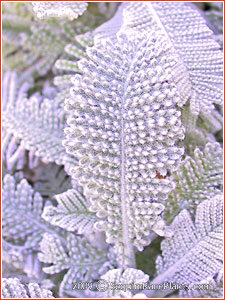
Tanacetum haradjanii
$10.95 Deeply cut, feathery leaves of silvery white are stunning on this perennial. We rarely if ever see flowers on it. This likes well drained soil and more sun than shade. Winter hardy to USDA zone 6. Mature height will be six inches with a width of twelve inches in a couple of years.
.jpg)